本文介绍了实现一个稀疏混合专家语言模型(MoE)的方法,详细解释了模型的实施过程,包括采用稀疏混合专家取代传统的前馈神经网络,实现 top-k 门控和带噪声的 top-k 门控,以及采用 Kaiming He 初始化技术。作者还说明了从 makemore 架构保持不变的元素,比如数据集处理、分词预处理和语言建模任务。最后还提供了一个 GitHub 仓库链接,用于实现模型的整个过程,是一本不可多得的实战教科书。
内容简介
混合专家模型(MoE)在发布后开始受到广泛关注,特别是在稀疏化的混合专家语言模型中。虽然大部分组件与传统的transformers相似,但稀疏混合专家语言模型的训练稳定性存在一些问题,尽管看上去相对简单。
这种可配置的小规模稀疏 MoE 实施方法在Hugging Face的一篇博客中被介绍了出来,这对于想要进行新方法快速试验的研究者来说可能非常有帮助。博客还提供了基于PyTorch的详细代码,可以在此链接找到:https://github.com/AviSoori1x/makeMoE/tree/main。这样的小规模实现有助于研究者们在这个领域进行快速试验。
本站对此进行了整理,以飨读者。
本文在 makemore 架构的基础上,进行了几处更改:
使用稀疏混合专家代替单独的前馈神经网络;
Top-k 门控和有噪声的 Top-k 门控;
参数初始化使用了 Kaiming He 初始化方法,但本文重点是可自定义初始化方法,包括选择 X*ier/Glorot 等初始化方法。
同时,以下模块与 makemore 保持一致:
数据集、预处理(分词)部分以及 Andrej 最初选择的语言建模任务 - 生成莎士比亚文风的文本内容
Casusal 自注意力机制
训练循环
推理逻辑
☞☞☞AI 智能聊天, 问答助手, AI 智能搜索, 免费无限量使用 DeepSeek R1 模型☜☜☜
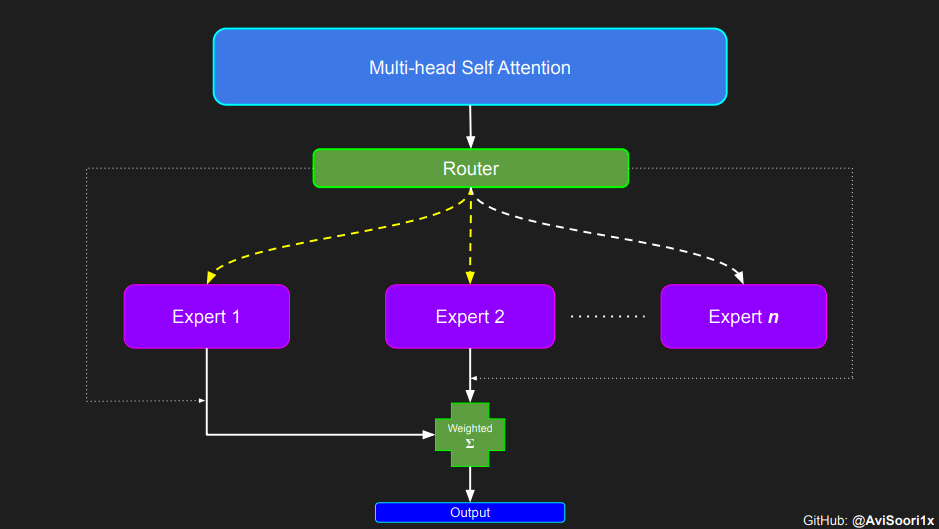
接下来逐步介绍实施方案,先从注意力机制开始。
因果缩放点积注意力机制
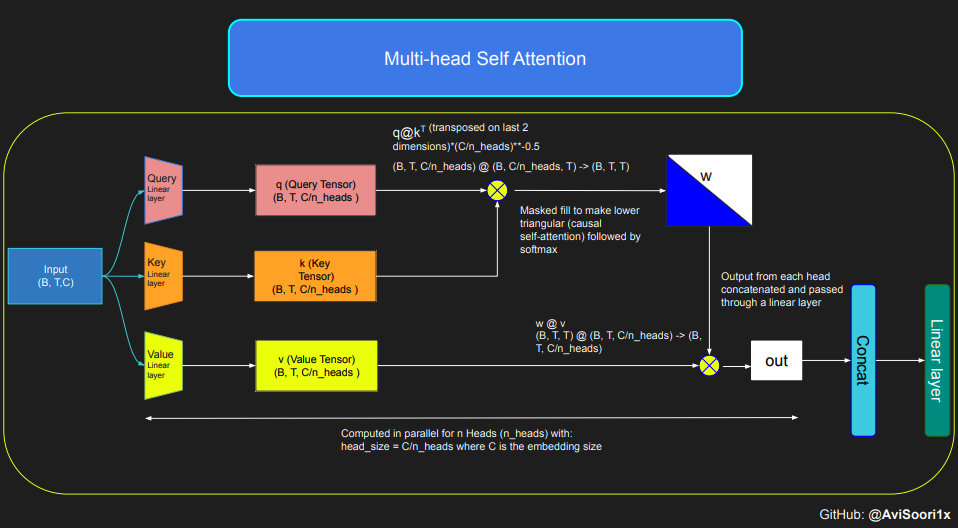
下面这段代码展示了自注意力机制的基本概念,并且侧重于使用经典的缩放点积自注意力(scaled dot product self-attention.)实现。在这一自注意力变体机制中,查询矩阵、键矩阵和值矩阵都来自相同的输入序列。同时为了确保自回归语言生成过程的完整性,特别是在纯解码器模型中,使用了一种掩码机制。
这种掩码机制非常关键,因为它可以掩盖当前 token 所处位置之后的任何信息,从而引导模型只关注序列的前面部分。这种了遮挡 token 后面内容的注意力被称为因果自注意力。值得注意的是,稀疏混合专家模型并不局限于仅有解码器的 Transformer 架构。事实上,这一领域的许多重要的成果都是围绕 T5 架构展开的,T5 架构也包含了 Transformer 模型中的编码器和解码器组件。
#This code is borrowed from Andrej Karpathy's makemore repository linked in the repo.The self attention layers in Sparse mixture of experts models are the same asin regular transformer modelstorch.manual_seed(1337)B,T,C = 4,8,32 # batch, time, channelsx = torch.randn(B,T,C)# let's see a single Head perform self-attentionhead_size = 16key = nn.Linear(C, head_size, bias=False)query = nn.Linear(C, head_size, bias=False)value = nn.Linear(C, head_size, bias=False)k = key(x) # (B, T, 16)q = query(x) # (B, T, 16)wei =q @ k.transpose(-2, -1) # (B, T, 16) @ (B, 16, T) ---> (B, T, T)tril = torch.tril(torch.ones(T, T))#wei = torch.zeros((T,T))wei = wei.masked_fill(tril == 0, float('-inf'))wei = F.softmax(wei, dim=-1) #B,T,Tv = value(x) #B,T,Hout = wei @ v # (B,T,T) @ (B,T,H) -> (B,T,H)out.shapetorch.Size([4, 8, 16])
然后,因果自注意力和多头因果自注意力的代码可整理如下。多头自注意力并行应用多个注意力头,每个注意力头单独关注通道的一个部分(嵌入维度)。多头自注意力从本质上改善了学习过程,并由于其固有的并行能力提高了模型训练的效率。下面这段代码使用了 dropout 来进行正则化,来防止过拟合。
#Causal scaled dot product self-Attention Headn_embd = 64n_head = 4n_layer = 4head_size = 16dropout = 0.1class Head(nn.Module):""" one head of self-attention """def __init__(self, head_size):super().__init__()self.key = nn.Linear(n_embd, head_size, bias=False)self.query = nn.Linear(n_embd, head_size, bias=False)self.value = nn.Linear(n_embd, head_size, bias=False)self.register_buffer('tril', torch.tril(torch.ones(block_size, block_size)))self.dropout = nn.Dropout(dropout)def forward(self, x):B,T,C = x.shapek = self.key(x) # (B,T,C)q = self.query(x) # (B,T,C)# compute attention scores ("affinities")wei = q @ k.transpose(-2,-1) * C**-0.5 # (B, T, C) @ (B, C, T) -> (B, T, T)wei = wei.masked_fill(self.tril[:T, :T] == 0, float('-inf')) # (B, T, T)wei = F.softmax(wei, dim=-1) # (B, T, T)wei = self.dropout(wei)# perform the weighted aggregation of the valuesv = self.value(x) # (B,T,C)out = wei @ v # (B, T, T) @ (B, T, C) -> (B, T, C) return out多头自注意力的实现方式如下:
#Multi-Headed Self Attentionclass MultiHeadAttention(nn.Module):""" multiple heads of self-attention in parallel """def __init__(self, num_heads, head_size):super().__init__()self.heads = nn.ModuleList([Head(head_size) for _ in range(num_heads)])self.proj = nn.Linear(n_embd, n_embd)self.dropout = nn.Dropout(dropout)def forward(self, x):out = torch.cat([h(x) for h in self.heads], dim=-1)out = self.dropout(self.proj(out)) return out
创建一个专家模块
即一个简单的多层感知器
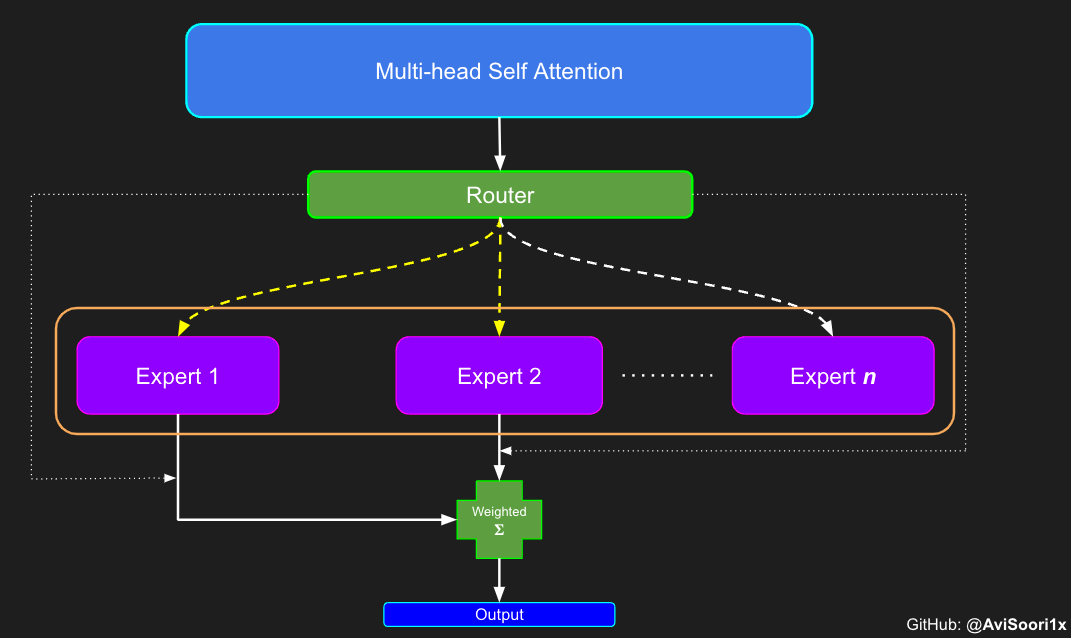
在稀疏混合专家架构中,每个 transformer 区块内的自注意力机制保持不变。不过,每个区块的结构发生了巨大的变化:标准的前馈神经网络被多个稀疏激活的前馈网络(即专家网络)所取代。所谓「稀疏激活」,是指序列中的每个 token 只被分配给有限数量的专家(通常是一个或两个)。
这有助于提高训练和推理速度,因为每次前向传递都会激活少数专家。不过,所有专家都必须存在 GPU 内存中,因此当参数总数达到数千亿甚至数万亿时,就会产生部署方面的问题。
#Expert moduleclass Expert(nn.Module):""" An MLP is a simple linear layer followed by a non-linearity i.e. each Expert """def __init__(self, n_embd):super().__init__()self.net = nn.Sequential(nn.Linear(n_embd, 4 * n_embd),nn.ReLU(),nn.Linear(4 * n_embd, n_embd),nn.Dropout(dropout),)def forward(self, x): return self.net(x)
Top-k 门控的一个例子
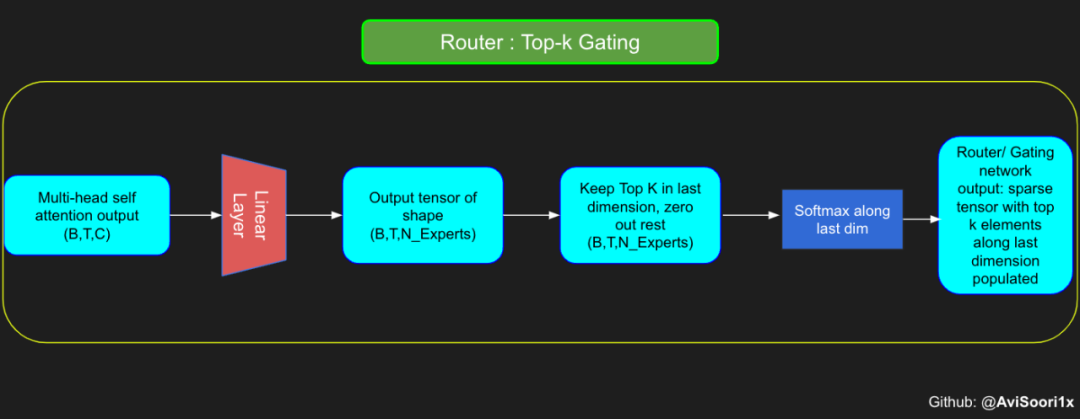
门控网络,也称为路由,确定哪个专家网络接收来自多头注意力的 token 的输出。举个例子解释路由的机制,假设有 4 个专家,token 需要被路由到前 2 个专家中。首先需要通过线性层将 token 输入到门控网络中。该层将对应于(Batch size,Tokens,n_embed)的输入张量从(2,4,32)维度,投影到对应于(Batch size、Tokens,num_expert)的新形状:(2、4,4)。其中 n_embed 是输入的通道维度,num_experts 是专家网络的计数。
接下来,沿最后一个维度,找出最大的前两个值及其相应的索引。
#Understanding how gating worksnum_experts = 4top_k=2n_embed=32#Example multi-head attention output for a simple illustrative example, consider n_embed=32, context_length=4 and batch_size=2mh_output = torch.randn(2, 4, n_embed)topkgate_linear = nn.Linear(n_embed, num_experts) # nn.Linear(32, 4)logits = topkgate_linear(mh_output)top_k_logits, top_k_indices = logits.topk(top_k, dim=-1)# Get top-k expertstop_k_logits, top_k_indices
#output:(tensor([[[ 0.0246, -0.0190],[ 0.1991,0.1513],[ 0.9749,0.7185],[ 0.4406, -0.8357]], [[ 0.6206, -0.0503],[ 0.8635,0.3784],[ 0.6828,0.5972],[ 0.4743,0.3420]]], grad_fn=<TopkBackward0>), tensor([[[2, 3],[2, 1],[3, 1],[2, 1]], [[0, 2], [0, 3], [3, 2], [3, 0]]]))
通过仅保留沿最后一个维度进行比较的前 k 大的值,来获得稀疏门控的输出。用负无穷值填充其余部分,在使用 softmax 激活函数。负无穷会被映射至零,而最大的前两个值会更加突出,且和为 1。要求和为 1 是为了对专家输出的内容进行加权。
zeros = torch.full_like(logits, float('-inf')) #full_like clones a tensor and fills it with a specified value (like infinity) for masking or calculations.sparse_logits = zeros.scatter(-1, top_k_indices, top_k_logits)sparse_logits#outputtensor([[[ -inf,-inf,0.0246, -0.0190], [ -inf,0.1513,0.1991,-inf], [ -inf,0.7185,-inf,0.9749], [ -inf, -0.8357,0.4406,-inf]],[[ 0.6206,-inf, -0.0503,-inf], [ 0.8635,-inf,-inf,0.3784], [ -inf,-inf,0.5972,0.6828], [ 0.3420,-inf,-inf,0.4743]]], grad_fn=<ScatterBackward0>)
gating_output= F.softmax(sparse_logits, dim=-1)gating_output
#ouputtensor([[[0.0000, 0.0000, 0.5109, 0.4891], [0.0000, 0.4881, 0.5119, 0.0000], [0.0000, 0.4362, 0.0000, 0.5638], [0.0000, 0.2182, 0.7818, 0.0000]],[[0.6617, 0.0000, 0.3383, 0.0000], [0.6190, 0.0000, 0.0000, 0.3810], [0.0000, 0.0000, 0.4786, 0.5214], [0.4670, 0.0000, 0.0000, 0.5330]]], grad_fn=<SoftmaxBackward0>)
使用有噪声的 top-k 门控以实现负载平衡
 Machine Translation
聚合多个来源的AI翻译
 49
查看详情
49
查看详情

# First define the top k router moduleclass TopkRouter(nn.Module):def __init__(self, n_embed, num_experts, top_k):super(TopkRouter, self).__init__()self.top_k = top_kself.linear =nn.Linear(n_embed, num_experts) def forward(self, mh_ouput):# mh_ouput is the output tensor from multihead self attention blocklogits = self.linear(mh_output)top_k_logits, indices = logits.topk(self.top_k, dim=-1)zeros = torch.full_like(logits, float('-inf'))sparse_logits = zeros.scatter(-1, indices, top_k_logits)router_output = F.softmax(sparse_logits, dim=-1) return router_output, indices接下来使用下面这段代码来测试程序:
#Testing this out:num_experts = 4top_k = 2n_embd = 32mh_output = torch.randn(2, 4, n_embd)# Example inputtop_k_gate = TopkRouter(n_embd, num_experts, top_k)gating_output, indices = top_k_gate(mh_output)gating_output.shape, gating_output, indices#And it works!!
#output(torch.Size([2, 4, 4]), tensor([[[0.5284, 0.0000, 0.4716, 0.0000],[0.0000, 0.4592, 0.0000, 0.5408],[0.0000, 0.3529, 0.0000, 0.6471],[0.3948, 0.0000, 0.0000, 0.6052]], [[0.0000, 0.5950, 0.4050, 0.0000], [0.4456, 0.0000, 0.5544, 0.0000], [0.7208, 0.0000, 0.0000, 0.2792], [0.0000, 0.0000, 0.5659, 0.4341]]], grad_fn=<SoftmaxBackward0>), tensor([[[0, 2],[3, 1],[3, 1],[3, 0]], [[1, 2], [2, 0], [0, 3], [2, 3]]]))
尽管最近发布的 mixtral 的论文没有提到这一点,但本文的作者相信有噪声的 Top-k 门控机制是训练 MoE 模型的一个重要工具。从本质上讲,不会希望所有的 token 都发送给同一组「受欢迎」的专家网络。人们需要的是能在开发和探索之间取得良好平衡。为此,为了负载平衡,从门控的线性层向 logits 激活函数添加标准正态噪声是有帮助的,这使训练更有效率。
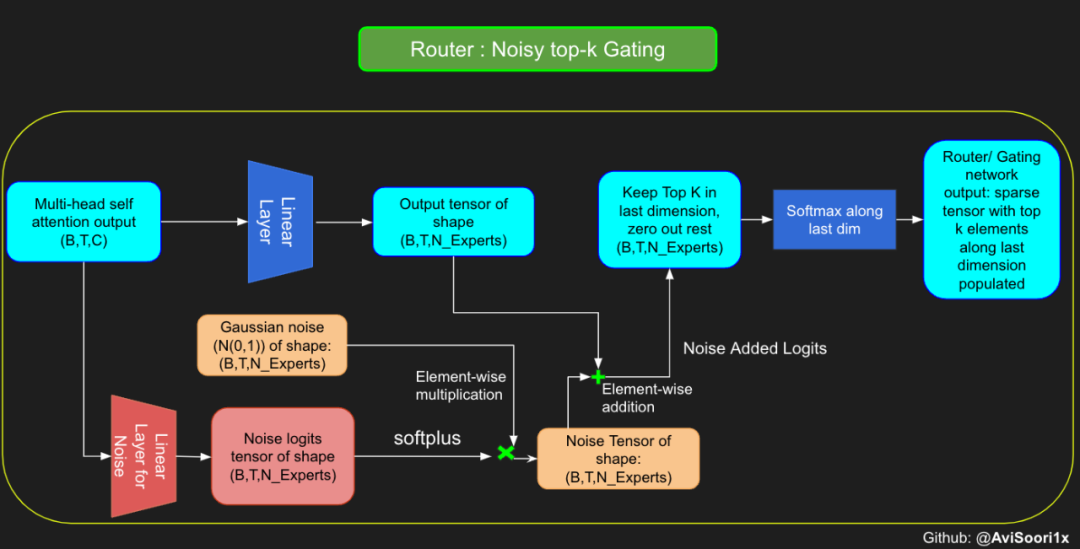
#Changing the above to accomodate noisy top-k gatingclass NoisyTopkRouter(nn.Module):def __init__(self, n_embed, num_experts, top_k):super(NoisyTopkRouter, self).__init__()self.top_k = top_k#layer for router logitsself.topkroute_linear = nn.Linear(n_embed, num_experts)self.noise_linear =nn.Linear(n_embed, num_experts)def forward(self, mh_output):# mh_ouput is the output tensor from multihead self attention blocklogits = self.topkroute_linear(mh_output)#Noise logitsnoise_logits = self.noise_linear(mh_output)#Adding scaled unit gaussian noise to the logitsnoise = torch.randn_like(logits)*F.softplus(noise_logits)noisy_logits = logits + noisetop_k_logits, indices = noisy_logits.topk(self.top_k, dim=-1)zeros = torch.full_like(noisy_logits, float('-inf'))sparse_logits = zeros.scatter(-1, indices, top_k_logits)router_output = F.softmax(sparse_logits, dim=-1) return router_output, indices再次尝试代码:
#Testing this out, again:num_experts = 8top_k = 2n_embd = 16mh_output = torch.randn(2, 4, n_embd)# Example inputnoisy_top_k_gate = NoisyTopkRouter(n_embd, num_experts, top_k)gating_output, indices = noisy_top_k_gate(mh_output)gating_output.shape, gating_output, indices#It works!!
#output(torch.Size([2, 4, 8]), tensor([[[0.4181, 0.0000, 0.5819, 0.0000, 0.0000, 0.0000, 0.0000, 0.0000],[0.4693, 0.5307, 0.0000, 0.0000, 0.0000, 0.0000, 0.0000, 0.0000],[0.0000, 0.4985, 0.5015, 0.0000, 0.0000, 0.0000, 0.0000, 0.0000],[0.0000, 0.0000, 0.0000, 0.2641, 0.0000, 0.7359, 0.0000, 0.0000]], [[0.0000, 0.0000, 0.0000, 0.6301, 0.0000, 0.3699, 0.0000, 0.0000], [0.0000, 0.0000, 0.0000, 0.4766, 0.0000, 0.0000, 0.0000, 0.5234], [0.0000, 0.0000, 0.0000, 0.6815, 0.0000, 0.0000, 0.3185, 0.0000], [0.4482, 0.5518, 0.0000, 0.0000, 0.0000, 0.0000, 0.0000, 0.0000]]], grad_fn=<SoftmaxBackward0>), tensor([[[2, 0],[1, 0],[2, 1],[5, 3]], [[3, 5], [7, 3], [3, 6], [1, 0]]]))
创建稀疏化的混合专家模块
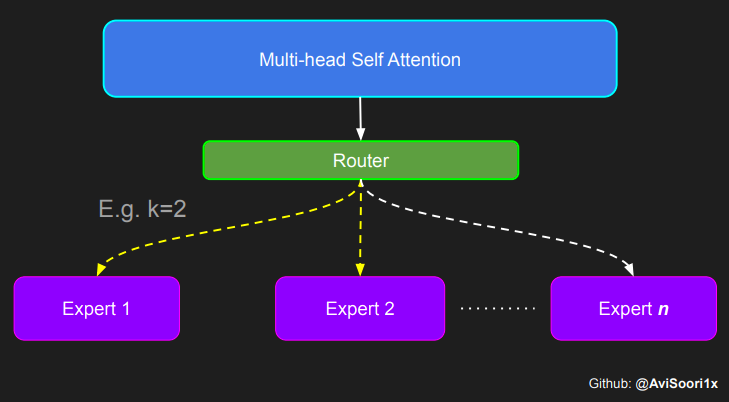
在获得门控网络的输出结果之后,对于给定的 token,将前 k 个值选择性地与来自相应的前 k 个专家的输出相乘。这种选择性乘法的结果是一个加权和,该加权和构成 SparseMoe 模块的输出。这个过程的关键和难点是避免不必要的乘法运算,只为前 k 名专家进行正向转播。为每个专家执行前向传播将破坏使用稀疏 MoE 的目的,因为这个过程将不再是稀疏的。
class SparseMoE(nn.Module):def __init__(self, n_embed, num_experts, top_k):super(SparseMoE, self).__init__()self.router = NoisyTopkRouter(n_embed, num_experts, top_k)self.experts = nn.ModuleList([Expert(n_embed) for _ in range(num_experts)])self.top_k = top_kdef forward(self, x):gating_output, indices = self.router(x)final_output = torch.zeros_like(x)# Reshape inputs for batch processingflat_x = x.view(-1, x.size(-1))flat_gating_output = gating_output.view(-1, gating_output.size(-1))# Process each expert in parallelfor i, expert in enumerate(self.experts):# Create a mask for the inputs where the current expert is in top-kexpert_mask = (indices == i).any(dim=-1)flat_mask = expert_mask.view(-1)if flat_mask.any():expert_input = flat_x[flat_mask]expert_output = expert(expert_input)# Extract and apply gating scoresgating_scores = flat_gating_output[flat_mask, i].unsqueeze(1)weighted_output = expert_output * gating_scores# Update final output additively by indexing and addingfinal_output[expert_mask] += weighted_output.squeeze(1) return final_output
运行以下代码来用样本测试上述实现,可以看到确实如此!
import torchimport torch.nn as nn#Let's test this outnum_experts = 8top_k = 2n_embd = 16dropout=0.1mh_output = torch.randn(4, 8, n_embd)# Example multi-head attention outputsparse_moe = SparseMoE(n_embd, num_experts, top_k)final_output = sparse_moe(mh_output)print("Shape of the final output:", final_output.shape)Shape of the final output: torch.Size([4, 8, 16])
需要强调的是,如上代码所示,从路由 / 门控网络输出的 top_k 本身也很重要。索引确定了被激活的专家是哪些, 对应的值又决定了权重大小。下图进一步解释了加权求和的概念。
模块整合
将多头自注意力和稀疏混合专家相结合,形成稀疏混合专家 transformer 块。就像在 vanilla transformer 块中一样,也要使用残差以确保训练稳定,并避免梯度消失等问题。此外,要采用层归一化来进一步稳定学习过程。
#Create a self attention + mixture of experts block, that may be repeated several number of timesclass Block(nn.Module):""" Mixture of Experts Transformer block: communication followed by computation (multi-head self attention + SparseMoE) """def __init__(self, n_embed, n_head, num_experts, top_k):# n_embed: embedding dimension, n_head: the number of heads we'd likesuper().__init__()head_size = n_embed // n_headself.sa = MultiHeadAttention(n_head, head_size)self.smoe = SparseMoE(n_embed, num_experts, top_k)self.ln1 = nn.LayerNorm(n_embed)self.ln2 = nn.LayerNorm(n_embed)def forward(self, x):x = x + self.sa(self.ln1(x))x = x + self.smoe(self.ln2(x)) return x
最后,将所有内容整合在一起,形成稀疏混合专家语言模型。
class SparseMoELanguageModel(nn.Module):def __init__(self):super().__init__()# each token directly reads off the logits for the next token from a lookup table self.token_embedding_table = nn.Embedding(vocab_size, n_embed) self.position_embedding_table = nn.Embedding(block_size, n_embed)self.blocks = nn.Sequential(*[Block(n_embed, n_head=n_head, num_experts=num_experts,top_k=top_k) for _ in range(n_layer)])self.ln_f = nn.LayerNorm(n_embed) # final layer normself.lm_head = nn.Linear(n_embed, vocab_size)def forward(self, idx, targets=None):B, T = idx.shape# idx and targets are both (B,T) tensor of integerstok_emb = self.token_embedding_table(idx) # (B,T,C)pos_emb = self.position_embedding_table(torch.arange(T, device=device)) # (T,C)x = tok_emb + pos_emb # (B,T,C)x = self.blocks(x) # (B,T,C)x = self.ln_f(x) # (B,T,C)logits = self.lm_head(x) # (B,T,vocab_size)if targets is None:loss = Noneelse:B, T, C = logits.shapelogits = logits.view(B*T, C)targets = targets.view(B*T)loss = F.cross_entropy(logits, targets)return logits, lossdef generate(self, idx, max_new_tokens):# idx is (B, T) array of indices in the current contextfor _ in range(max_new_tokens):# crop idx to the last block_size tokensidx_cond = idx[:, -block_size:]# get the predictionslogits, loss = self(idx_cond)# focus only on the last time steplogits = logits[:, -1, :] # becomes (B, C)# apply softmax to get probabilitiesprobs = F.softmax(logits, dim=-1) # (B, C)# sample from the distributionidx_next = torch.multinomial(probs, num_samples=1) # (B, 1)# append sampled index to the running sequenceidx = torch.cat((idx, idx_next), dim=1) # (B, T+1) return idx
参数初始化对于深度神经网络的高效训练非常重要。由于专家中存在 ReLU 激活,因此这里使用了 Kaiming He 初始化。也可以尝试在 transformer 中更常用的 Glorot 初始化。杰里米 - 霍华德(Jeremy Howard)的《Fastai》第 2 部分有一个从头开始实现这些功能的精彩讲座:https://course.fast.ai/Lessons/lesson17.html
Glorot 参数初始化通常被用于 transformer 模型,因此这是一个可能提高模型性能的方法。
def kaiming_init_weights(m):if isinstance (m, (nn.Linear)): init.kaiming_normal_(m.weight)model = SparseMoELanguageModel()model.apply(kaiming_init_weights)
本文作者使用 mlflow 跟踪并记录重要指标和训练超参数。
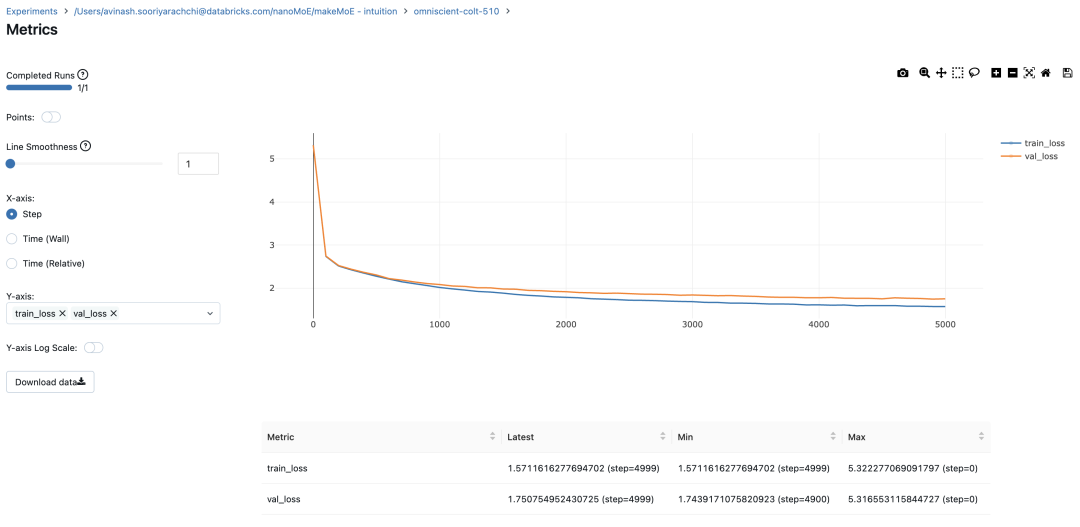
#Using MLFlowm = model.to(device)# print the number of parameters in the modelprint(sum(p.numel() for p in m.parameters())/1e6, 'M parameters')# create a PyTorch optimizeroptimizer = torch.optim.AdamW(model.parameters(), lr=learning_rate)#mlflow.set_experiment("makeMoE")with mlflow.start_run():#If you use mlflow.autolog() this will be automatically logged. I chose to explicitly log here for completenessparams = {"batch_size": batch_size , "block_size" : block_size, "max_iters": max_iters, "eval_interval": eval_interval,"learning_rate": learning_rate, "device": device, "eval_iters": eval_iters, "dropout" : dropout, "num_experts": num_experts, "top_k": top_k }mlflow.log_params(params)for iter in range(max_iters):# every once in a while evaluate the loss on train and val setsif iter % eval_interval == 0 or iter == max_iters - 1:losses = estimate_loss()print(f"step {iter}: train loss {losses['train']:.4f}, val loss {losses['val']:.4f}")metrics = {"train_loss": losses['train'], "val_loss": losses['val']}mlflow.log_metrics(metrics, step=iter)# sample a batch of dataxb, yb = get_batch('train')# evaluate the losslogits, loss = model(xb, yb)optimizer.zero_grad(set_to_none=True)loss.backward()optimizer.step()8.996545 M parametersstep 0: train loss 5.3223, val loss 5.3166step 100: train loss 2.7351, val loss 2.7429step 200: train loss 2.5125, val loss 2.5233...step 4999: train loss 1.5712, val loss 1.7508
记录训练和验证损失可以很好地指示训练的进展情况。该图显示,可能应该在 4500 次时停止(当验证损失稍微增加时)
接下来可以使用这个模型逐字符自回归地生成文本。
# generate from the model. Not great. Not too bad eithercontext = torch.zeros((1, 1), dtype=torch.long, device=device)print(decode(m.generate(context, max_new_tokens=2000)[0].tolist()))
DUKE VINCENVENTIO:If it ever fecond he town sue kigh now,That thou wold'st is steen 't.SIMNA:Angent her; no, my a born Yorthort,Romeoos soun and lawf to your sawe with ch a woft ttastly defy,To declay the soul art; and meart smad.CORPIOLLANUS:Which I cannot shall do from by born und ot cold warrike,What king we best anone wr*e's going of heard and goodThus playvage; you h*e wold the grace....
本文参考内容:
在实施过程中,作者大量参考了以下出版物:
混合专家模型:https://arxiv.org/pdf/2401.04088.pdf
超大型神经网络:稀疏门控混合专家层:https://arxiv.org/pdf/1701.06538.pdf
来自 Andrej Karpathy 的原始 makemore 实现:https://github.com/karpathy/makemore
还可以尝试以下几种方法,来提高模型性能:
提高混合专家模块的效率;
尝试不同的神经网络初始化策略;
从字符级到子词级的分词;
对专家数量和 k 的取值(每个 token 激活的专家数量)进行贝叶斯超参数搜索。这可以归类为神经架构搜索。
优化专家能力。
以上就是手把手教你,从零开始实现一个稀疏混合专家架构语言模型(MoE)的详细内容,更多请关注其它相关文章!
# 使用了
# 灰帽子seo什么意思
# 海城网站推广营销
# 普通网站建设的内容
# 广州搜索关键词排名全网
# 按效果推广营销公司
# 高端网站建设分析论文
# 武隆网站高端建设项目
# 优化内容网站结构分析
# seo打包人士收入
# 网站建设高端品牌排行
# 腾讯
# 是在
# 入门
# 是一个
# 这段
# 多个
# 的是
# 手把手教你
# 从零开始
# 门控
# type
# follow
# sider
# hugging face
相关栏目:
【
Google疑问12 】
【
Facebook疑问10 】
【
优化推广96088 】
【
技术知识133117 】
【
IDC资讯59369 】
【
网络运营7196 】
【
IT资讯61894 】
相关推荐:
AI立法迫在眉睫,如何看对行业影响?
AI 冥想应用 Ogimi.ai 推出,可为用户提供教练级个性化指导
五个IntelliJ IDEA插件,高效编写代码
特斯拉 Optimus 人形机器人入驻北美门店,帮助提升汽车销量
探展WAIC | 第四范式“式说”聚焦toB大模型,布局生成式AI重构企业软件
聚焦WAIC|AI技术支撑大模型探索未来
AI框架生态峰会本周开幕 华为昇腾“朋友圈”再聚首 全球首个全模态大模型将登场
无人机在电力巡检中的应用:全面解析高效巡检流程
Stability AI 推出文生图模型 SDXL0.9,GPU要求下探至消费级水平
OpenAI首席执行官表态支持欧盟AI监管
微软推出 LLaVA-Med AI 模型,可对医学病理案例进行分析
Meta发布语音AI模型 Voicebox 助虚拟助手与NPC对话
500元一张的AI艺术二维码制作,详细教程来了!
绿联发布笑脸屏幕显示充电状态的30W/65W Q湃机器人充电器
人工智能颠覆软件测试四大方式
中国移动主导创立元宇宙产业联盟,包括科大讯飞、芒果TV等在内,共24家成员
首个算网生态体!中国移动元宇宙产业联盟正式成立
IBM与NASA联手开源地理空间AI基础模型,促进气候科学领域进步
探展WAIC |万向区块链杜宇:不存在单一技术的iPhone时刻,Web3.0核心将基于AI+区块链+物联网
AIGC 风潮刮到游戏产业,巨人网络与阿里云达成“游戏 +AI ”合作
这款在《自然通讯》发表的机器人,为变形金刚来到现实创造可能性
1.6亿美元收购Singularity AI,昆仑万维布局通用人工智能
马斯克回应“人工智能让一切变得更好”:我们已经是半机器人了
苹果CEO库克:持续研究生成式人工智能技术
拓普龙7188ML:轻便壁挂式工控机箱,为人工智能应用场景提供有力保障
给小朋友最好的科技礼物:乐天派桌面机器人
ChatGPT会成为你家新的语音助手吗?
Meta将VR头显最低年龄限制从13岁降至10岁
RoboNeo什么时候上线
ChatGPT 可以设计机器人吗?
“上海市民营企业人工智能赋能创新中心”揭牌成立
生成式AI对云运维的3大挑战
微软在 Bing 和 Edge 浏览器中拓展网购服务,帮用户选购心仪产品
人工智能赋能广西自然资源领域监测监管
江永:精准施训提升通信无人机应急救援能力
马斯克讽刺人工智能炒作:什么“机器学习”,其实就是统计
AI大模型紫东太初已被注册商标 中科院已注册紫东太初大模型商标
这效果能打几分?AI真人化《名侦探柯南》
Moka发布AI原生HR SaaS产品“Moka Eva”,布局AGI时代
AI新视野,增长新势能,伙伴云受邀出席笔记侠创业讲真话AI峰会
AI生成会议纪要 百度如流升级推出超级助手、智能编码等功能
MetaGPT AI 模型开源:可模拟软件公司开发过程,生成高质量代码
“具身智能”引爆机器人产业,看绝影Lite3/X20四足机器人有何特别之处?
当一切设备都受到人工智能的控制
首家承认ChatGPT影响其收入的公司Chegg选择拥抱AI ,裁减4%员工
商汤科技:元萝卜 AI 下棋机器人新品发布会 6 月 14 日举行
WHEE网页地址入口
国内阅读行业首款对话式AI应用“阅爱聊”封闭内测
WHEE安装教程
AI赋能艺术 超现实达利奇幻之旅在沪开启
2024-02-16

运城市盐湖区信雨科技有限公司是一家深耕海外推广领域十年的专业服务商,作为谷歌推广与Facebook广告全球合作伙伴,聚焦外贸企业出海痛点,以数字化营销为核心,提供一站式海外营销解决方案。公司凭借十年行业沉淀与平台官方资源加持,打破传统外贸获客壁垒,助力企业高效开拓全球市场,成为中小企业出海的可靠合作伙伴。

 nsidx_cond = idx[:, -block_size:]# get the predictionslogits, loss = self(idx_cond)# focus only on the last time steplogits = logits[:, -1, :] # becomes (B, C)# apply softmax to get probabilitiesprobs = F.softmax(logits, dim=-1) # (B, C)# sample from the distributionidx_next = torch.multinomial(probs, num_samples=1) # (B, 1)# append sampled index to the running sequenceidx = torch.cat((idx, idx_next), dim=1) # (B, T+1) return idx